In late august, I rode a coach bus over the Sierra Nevada Mountains, past Reno, and across the Pyramid Lake Paiute Reservation. Six hours after leaving San Francisco, I entered the Black Rock Desert. I was there for Burning Man: a week-long event where 63,000 people create a temporary city dedicated to art, self-expression, decommodification, and self-reliance. True to its name, the event culminates in the symbolic burning of a fifty-foot-tall wooden effigy known as “The Man.” This was my first time at Burning Man, making me a “Burgin,” or virgin “Burner,” as participants often call themselves.
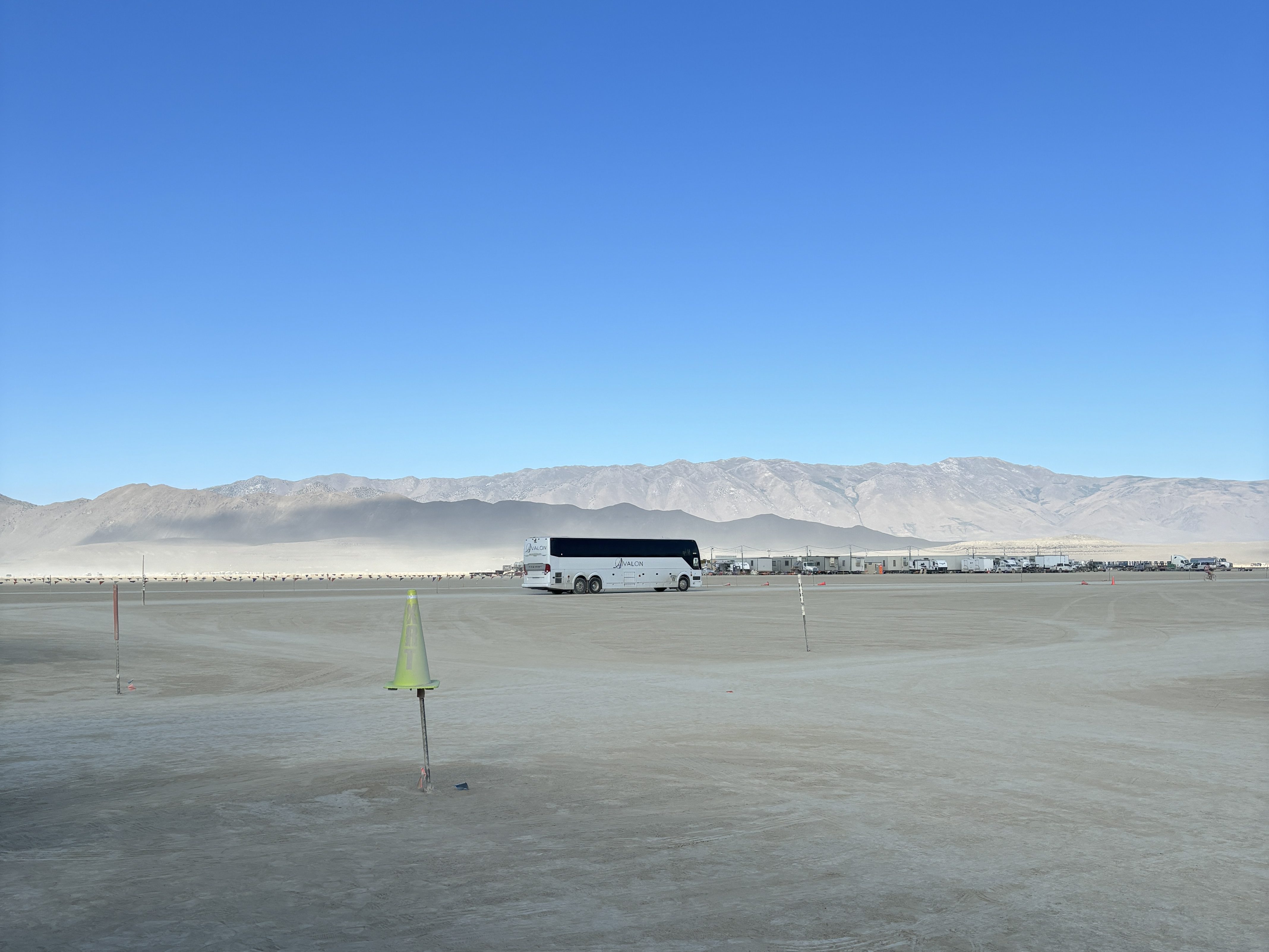
I attended Burning Man as part of my anthropological research on AI development in the Bay Area. While I was aware of the event’s historical significance for the region’s counterculture and its enduring prominence in Silicon Valley, it wasn’t until moving to San Francisco in June 2023 that I fully grasped the extent of its influence. The AI researchers and developers I met often identified themselves as Burners and frequently urged me to attend. So, seeking more context on my field site—and in the mood to get my hands dirty—I followed them to Nevada. Along with my camping gear and flashy outfits, I brought with me a research question: what was Burning Man’s particular appeal for the technologists I’ve met during my project?
Before the Burn, I read some of the social scientific research about the event. This included a 2009 essay by Stanford historian Fred Turner that asks the very same question. After attending himself, he argued that Burning Man mirrors the ideals, ethos, and social structure of Bay Area’s new media industry. In his view, the Burn provides a direct, intense experience of the internet’s DIY individualism and creative commons ideals. I found Turner’s account convincing, but I was curious how the event might have changed over the past 15 years and what my own experience could add to the story. Moreover, while he and others have made a great deal of Burning Man’s peculiar social and cultural dynamics, less has been said about its unique and rather extreme physical setting: the Black Rock Desert, or “The Playa.”
What follows is a note from the field that responds to my initial question. My thoughts are not definitive, as a mere Burgin can only learn so much on one trip. Nonetheless, I aim to motivate further research and germinate more conversations about the topic. I also want to express a shift in my own perspective—one that demonstrates, I hope, the virtues of ethnographic research. Leading up to the event, I was uneasy about joining a mostly well-off crowd, some of them billionaires, on their desert fantasy. I was concerned about its uneasy relation with climate change and the incursion on Paiute land. And to be honest, I feared I would find the event overly earnest, tacky, or even lame. I may retain my concerns and still don’t quite consider myself the event’s target audience, but I found an experience with enormous meaning for its participants—one that enables them (and the observer) to better understand their lives more broadly.
Playafication
Upon arrival, my bus mates and I were greeted by volunteers wielding megaphones. After providing some practical tips for getting to our camps, they summoned all Burgins to step forward. We must complete a ritual, they explained. One by one, we would throw ourselves onto the ground and create “dust angels” by waving our arms and legs in the dust as if it were snow. The effect was to coat our bodies with the fine, alkaline particulate. “You’re gonna get dusty anyways, so you might as well get it over with,” they reasoned. With some trepidation, then, we took turns bathing in the dust. We were then told to approach a large bell, where we would each set a personal intention for the week and strike the bell with a piece of metal rebar. The resonant tone marked our official induction as Burners. Over the course of the week, we became more comfortable with our new status, learning more of the community’s terminology, traditions, values, and history. We were “playafied,” as Burners call it, not only culturally but physically, as the dust accumulated on our bodies and belongings. We learned to accept the dust as a matter of course on the Playa.
There’s plenty of talk about matter at Burning Man. The festival has strict policies around cleaning up after oneself, removing all MOOP, or “matter out of place” in an attempt to preserve the desert. MOOP may be a Burner term, but it will sound familiar to many anthropologists. There’s a famous line by anthropologist Mary Douglas who, in Purity and Danger, defines dirt “as matter out of place.” Dirt is not dirt because of its inherent composition, she argues, but because it doesn’t belong in a particular place at a particular time in a particular cultural setting. Initially, my default sensibilities led me to perceive dust in the same way, but that changed when, after I once described my tent as increasingly “dirty” to a veteran campmate, they swiftly responded: “that’s not dirt, that’s dust!” At Burning Man, dust is not matter out of place; instead, it’s matter that makes the place.
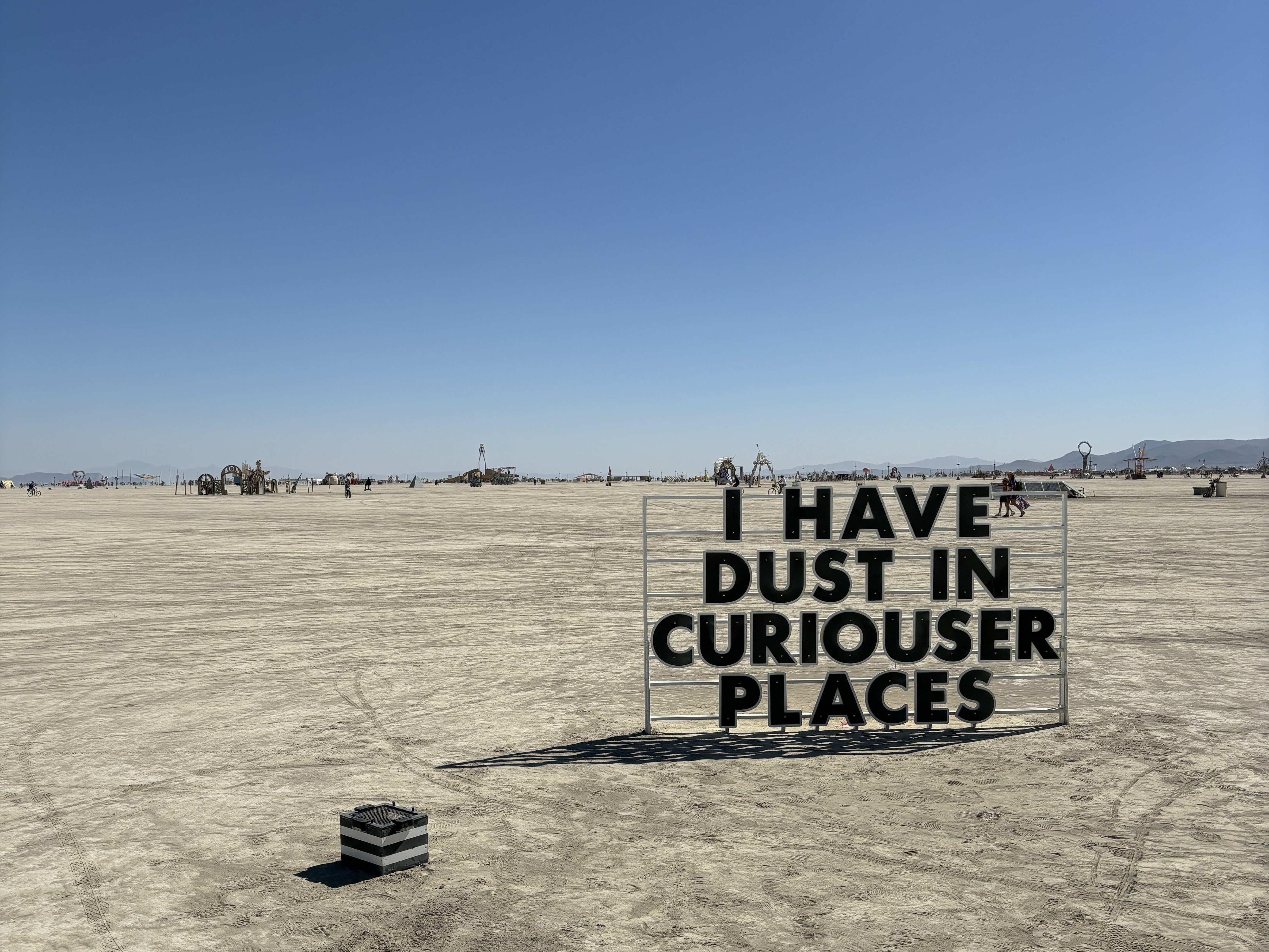
The desert itself reinforced this lesson on the final night of the Burn, when we experienced a rare evening dust storm. It began when most of us were out of camp, forcing us to return in whiteout conditions. By then, my camp had already taken down most of its structures, leaving us with only the kitchen tent for shelter. Huddled among the camp stoves and remaining provisions, we reflected on our memorable week and this unexpected conclusion. My camp mate—the same as above—welcomed the storm. “You Burgins are so lucky to experience this,” they exclaimed, adding that “the dust is where the magic happens!” Seizing this opportunity, they had us Burgins repeat the initiation ritual for all to witness. After the dust angels and ringing of a bell, they added a flourish, drawing a line in the dust for us to cross upon accepting our new status as Burners.[1]
Fred Turner’s work may point to the idealist aspects of Burning Man that technologists may find appealing, but after experiencing the event first-hand, speaking with Burners during and after the event, and filling my journal with field notes, I can’t help but ask about the meaning of its material aspects for technologists—especially the dust and all it entails. So in place of my initial question, I’ve swapped in a more specific one: What do Bay Area technologists living in a mild climate and working in digital industries gain from immersing themselves in the dust of Burning Man?
Dustcraft
Burning Man has ten guiding principles, and they can only be truly grasped, I’d argue, by following how they unfold at the actual event. This is particularly true for the principle of “Radical Self-reliance”:
Burning Man encourages the individual to discover, exercise and rely on their inner resources.
On the Playa, self-reliance means survival in an environment that is hostile to human life. August daytime temperatures regularly exceeded 90 Fahrenheit, and on this flat expanse (this was previously an ancient lakebed), there are no natural sources of shade. At night, temperatures dip into the 40s and leave us shivering in our tents. In turn, the temperature swings encourage plenty of wind, filling the air and our eyes and lungs with dust. The conditions challenge the body, and by the end of this year’s Burn, many of us, myself included, experienced hoarse voices, cracked skin, and even bloody noses.
Humans must employ the intensive use of technology to survive in such conditions, and for them to flourish on the Playa, which is really the goal, even more technology is required. All 1,500 camps need infrastructure for water storage and distribution, waste management, food preservation, and shelter from the sun and wind. To bring their unique themes to life, they need sophisticated lighting and powerful audio equipment, among other media technologies. Building this takes immense effort which often begins months before the event. For example, one friend, an SF-based software engineer, helped construct his camp’s water system. He and his camp mates designed a network of pumps and monitoring devices to ensure a steady supply of water for drinking, cooking, and hygiene. They built its components throughout the spring and summer and assembled the system on site one week before the burn. Other members of his camp, as in mine and more, built impressive, often climbable structures from wood and metal tubing to create a relatively comfortable, communal, and inspiring living environment. Some camps created fully immersive experiences: take Golden Guy Camp, for example, which built a passage of small bars inspired by the famous Tokyo alleyway of the same name.
Learning and exercising new skills for Burning Man is a core part of the experience. There’s even a designated section about this in the annual Black Rock City Census, an ongoing research project seeking to better understand the community. In the 2023 census (and again this year), respondents were asked if the experience inspired them to learn or practice new skills. They confirmed picking up skills in art creation/crafting (59%), survival skills (38%), carpentry or metal work (18%), electrical engineering (15%), and construction or mechanical work (14%). Experiencing the products of these skills make up much of the festival’s actual experience. In camp, we would make use of the infrastructure we built to support one another, and day and night, we would explore other camps and their impressive constructions. When asked about one’s camp, it’s customary to boast about what it has built and what experiences it offers. It’s a way of inviting people in and sharing the products of the camp’s labor.
In the “default world” (as Burners often call their lives outside the Burn), many tech workers build products and systems over which they have little control or ownership. They rarely experience the full extent of their creations’ uses or impacts. On the other hand, Burning Man offers these workers a rare opportunity engage in technical labor that directly and consequentially influences the world they inhabit. This labor sustains and enriches their own lives and the lives of their temporary community. During the Burn, they can live in a world they and their peers designed and produced. The Playa doesn’t just equip tech workers with a sandbox to play in—it affords them one they can inhabit. And the intensity of its conditions in turn increases the intensity of this experience: it increases the stakes, consequences, and potential of their technical labor.
Dust, Sea, and Space
The Playa is not the only place where human life requires technology to survive. In this quality, the Playa resembles the open sea and outer space. There, too, humans cannot naturally survive, but again, they have used technology to do so. As a result, sea and space exploration have been particularly stimulating for technological development. Here’s a list of nautically cultivated arts from The Marvelous Clouds by media theorist John Durham Peters: “navigation…mapping, timekeeping, documentation, carpentry, waterproofing, provisioning and preservation, containerization, division of labor…fire control…alarm calls, and political hierarchy. Even nutrition.” Space travel has adopted many of these techniques, and it continues their development through advancements in fields like propulsion, energy storage, materials engineering, computing, and communications. Even the cyborg emerged from the challenge of sustaining human life in space. With the technical commonalities, space travel draws plenty of metaphors from seafaring, too—metaphors that extend into cyberspace, as Peters also observes. For example: “surfing” the internet, “floods” of information, and docks, cables, and ports. Given these domains’ inherent technicity for humans, it’s no wonder why space exploration and sea-steading are increasingly popular fascinations in Silicon Valley.
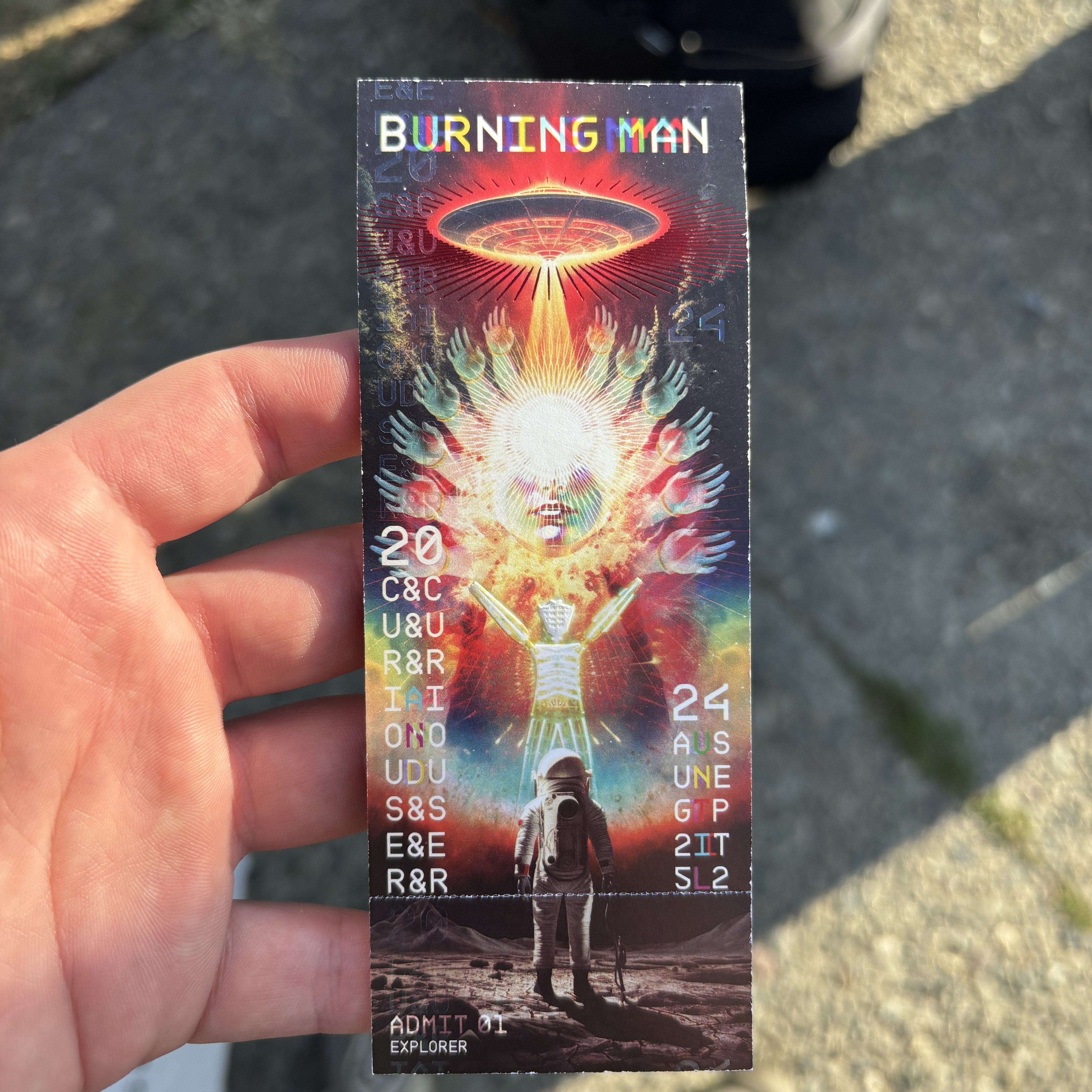
Burning Man takes up many of the techniques of sea and space travel. To some extent, it does so on a practical level, employing many of the crafts listed above. In addition, and to perhaps an even greater extent, it adopts these techniques through metaphor and imagery. The aesthetic connections are clear as soon as you get the entry ticket: this year’s ticket featured an astronaut standing on a rocky alien surface with a UFO flying above, its tractor beam activated. The camp across from mine placed a giant UFO above the street. Elsewhere in the temporary city, camps built geodesic domes to house their facilities. Some of the art featured extraterrestrial imagery, for example one featuring massive, inflated spheres depicting the Earth, Moon, and Mars. Other artworks opted for nautical references, like a shipwreck visited by a sea serpent. The art cars or “mutant vehicles” took similar cues: there were space shuttles, yachts, a flame-throwing octopus, and even the Golden Gate Bridge. These dustcraft, so to speak, descend from seacraft and spacecraft.
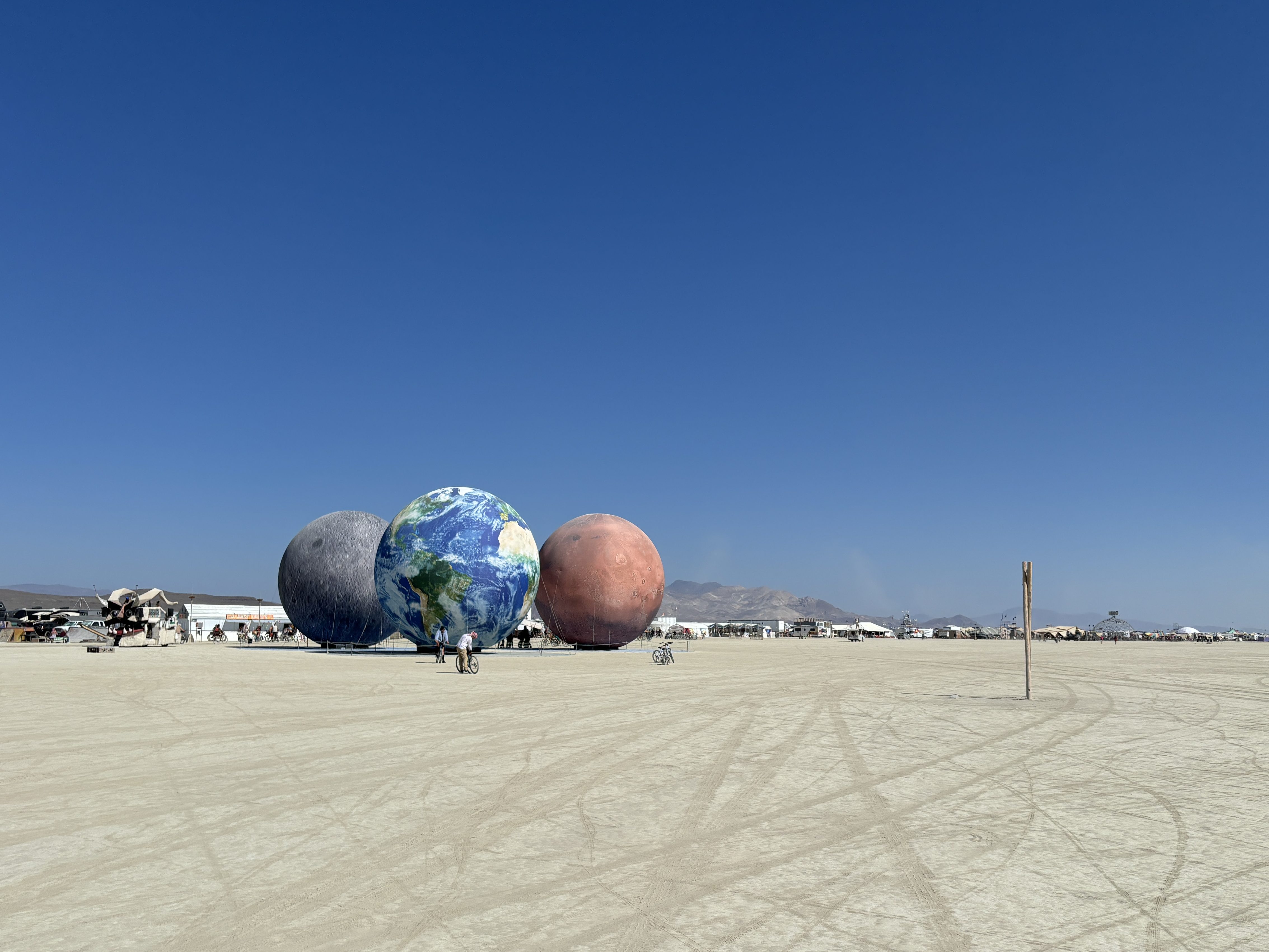
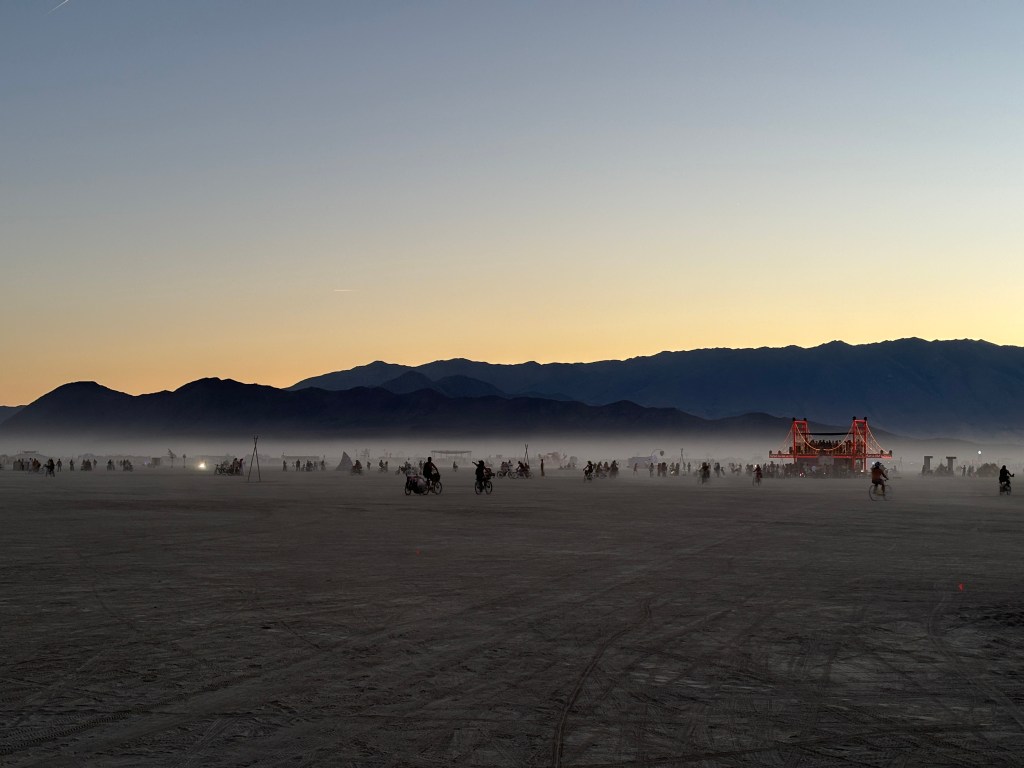
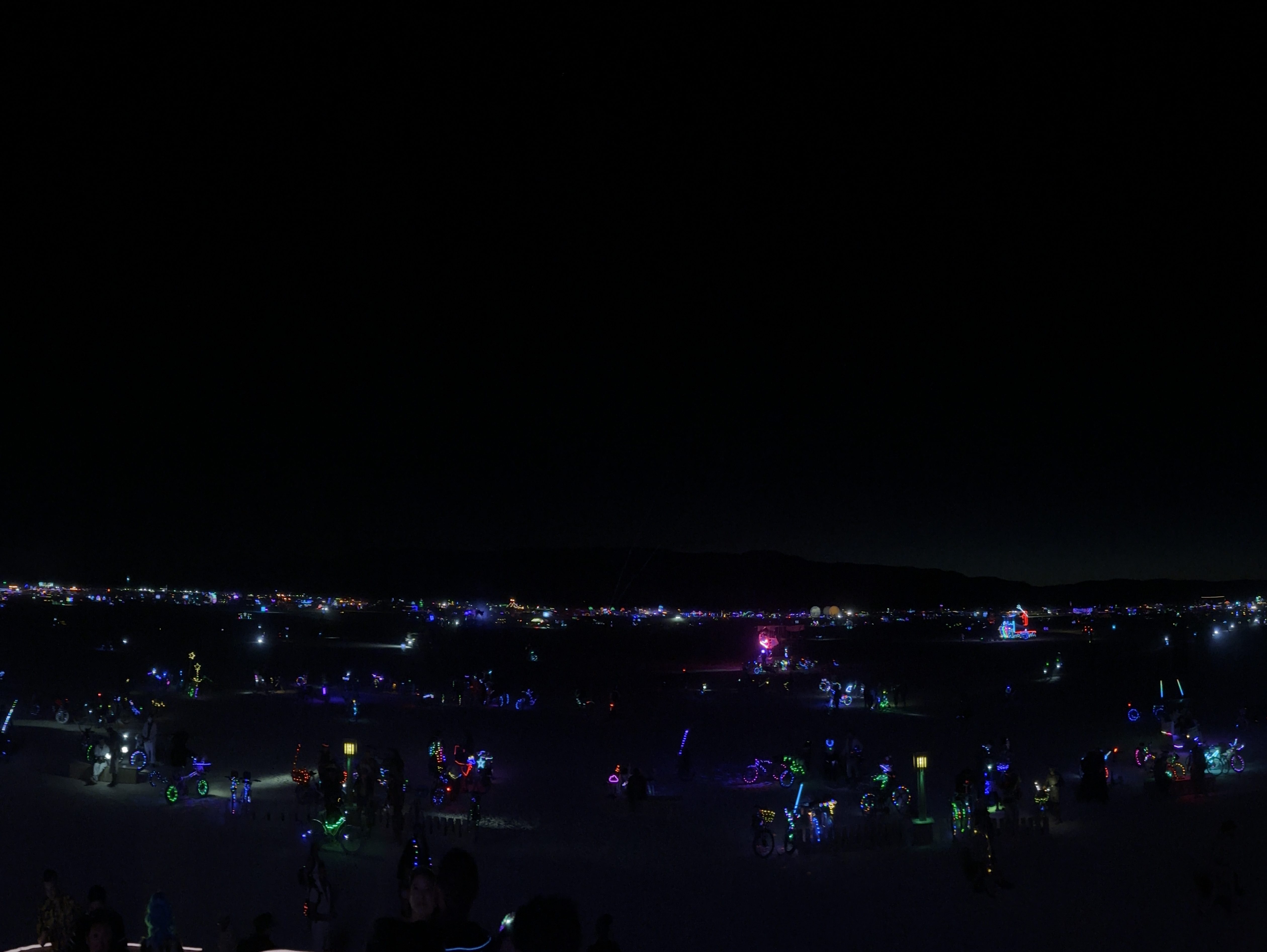
The connections between these domains extend to phenomenal experience. In other words, going to Burning Man simply feels like being at sea and in space. To explore the Playa, most Burners traverse it with bicycles and art cars, hopping between art installations and musical performances. At night, the darkness obscures the dust and blurs the boundary between land and sky. Standing becomes floating and driving becomes sailing. When lit by LEDs and flames, the reflective dust resembles a lunar surface. Gusts of wind mimic ocean gales, and the temperature drops evoke the chilling vacuum of space. Each location becomes a world unto itself, surrounded by darkness with only glimmers of other worlds in the distance. One might as well be crossing an archipelago or constellation. The Playa, like sea and space, invites exploration. Every morning over breakfast, we would report our findings from the previous night, exchanging them for tips on new sites to visit during our next voyage.
In his reflections on maritime technologies, Peters argues that the ship, as “the first completely artificial environment for human dwelling, is an allegory for civilization.” Spaceships extend this allegory, bringing it into a science-fictional future. Situated somewhere between a past at sea and a future in space, Burning Man offers a version of this allegory, too, and in a form that can be experienced not only in the present, but in a comparatively more accessible manner. Camping in the Black Rock Desert for a week may be an intense undertaking, but it’s far easier—and less risky—than crossing the ocean or blasting into space.
Deplayafication: From Burning Man to Artificial Intelligence
Following the burn, the dust clung to all my belongings and imprinted on everything I touched. The bus I rode home sported plastic garbage bags on its seats in an effort to keep them dust-free. I found this amusing but mildly humiliating; carried into the default world the dust had become dirt—it had become matter out of place—and so had I so long as it clung to my person. The Burner’s final trial of the week, then, is “deplayafication,” or the painstaking removal of dust from oneself and one’s things. But what do Burners keep after the pesky dust is gone?
I ask this question about those who convinced me to attend the Burn in the first place: the AI researchers and engineers I work with as part of my larger project. My hypothesis points to the civilizational experience I just described. As I’ve observed (and will eventually write about), AI is not just a thinking machine; it’s also a machine to think with—often on a civilizational scale. When AI researchers and engineers work on the latest machine learning models, they frequently grapple with the implications of their technologies for the future of humanity. This is sometimes called making a world model—a conceptual understanding of the world and its complex dynamics. But building and updating one is complicated by what those in the field call AI models’ “emergent” properties, or capacities that seem to arise spontaneously as the models increase in scale and sophistication. Faced with these emergent properties, the researchers and engineers expect future models to acquire fundamentally different natures than today’s iterations, making it difficult to imagine their implications for the future of civilization. To develop a world model, they engage in thought experiments, build analogies with human behavior, and employ other abstract techniques. Nonetheless, they struggle to overcome the uncertainty introduced by emergence. In this context, one must consider whether Burning Man provides a uniquely material way forward—a way to contemplate civilization by experiencing it in a smaller, more immediate, and intensely physical form. In this sandbox world, participants can explore new forms of social, technical, and individual transformation of the kinds they might expect, or at least want to see in the future. Burning Man may offer a world model made of dust.
Acknowledgments: Thanks to my friends Emmett and Sean for their generous comments, some of which I could incorporate here and others I hope to address in future work. The work benefits from their rich perspectives on the SF tech scene, but any issues with the above writing are my fault, not theirs. And thanks, of course, to my camp for welcoming me and enabling such a unique and enriching opportunity.
[1] This addition may have come from an earlier version used by the Cacophony Society, a San Francisco group involved in the origins of Burning Man.
 Spencer Kaplan